
7 Best AI Call Center Solutions for Healthcare in 2026
Compare seven healthcare AI call center platforms for appointment scheduling, after-hours calls, multi-location routing, EHR workflows, and safe human handoff.
Most healthcare AI call center demos sound impressive. The harder question is what happens after a real patient says, "I need the Brooklyn location, I have Medicaid, and I can only come after work." A useful system has to do more than answer the phone. It needs to understand the request, follow the clinic's scheduling rules, write the right appointment into the right calendar, and hand the call to a person when automation should stop.
This guide compares seven healthcare AI call center solutions by the work they are designed to handle: appointment scheduling, multi-location routing, after-hours coverage, patient access, EHR workflows, and safe human escalation. Product capabilities and pricing change, so confirm current scope, integrations, and contract terms directly with each vendor before buying.
Quick comparison: healthcare AI call center solutions
| Platform | Best fit | Primary strength | Pricing approach |
|---|---|---|---|
| healow Genie | Practices using healow or eClinicalWorks workflows | Patient self-service, scheduling, after-hours support, and human escalation | Contact vendor |
| BestDoc | Growing and multi-location practices | Voice AI connected to appointment booking and practice operations | Custom proposal |
| Prosper AI | Large patient-access and revenue-cycle teams | Patient and payer calls across scheduling, eligibility, and billing | Contact vendor |
| Assort Health | Specialty and multi-specialty groups | Specialty-aware patient access and proactive outreach | Contact vendor |
| Sully.ai | Hospitals exploring several AI roles | Receptionist, documentation, and broader clinical operations agents | Contact vendor |
| Hippocratic AI | Health systems with non-diagnostic patient engagement programs | Patient-facing healthcare agents and supervised workflows | Contact vendor |
| Telnyx Voice AI | Teams building a custom voice product | Programmable voice, telephony, speech, and deployment infrastructure | Usage-based; verify current rates |
Short answer: start with the workflow, not the voice. A clinic that mainly needs appointment booking should shortlist platforms with real-time schedule access and visit-reason rules. A health system automating payer calls needs a different product. A team building its own agent needs programmable infrastructure rather than an out-of-the-box medical receptionist.
What to compare before choosing a healthcare voice AI platform
Can it complete an appointment, not just capture a message?
Ask the vendor to demonstrate a new-patient booking from start to finish. The test should include the real constraints that make scheduling difficult: provider location, visit reason, insurance, appointment length, new-versus-existing patient rules, and unavailable time slots. A transcript that ends with "someone will call you back" may reduce voicemail, but it does not solve scheduling.
Can it route calls across locations and specialties?
Multi-location groups need more than a general phone tree. The agent should identify the correct location, provider, service, and escalation path without creating duplicate patient records or putting an appointment on the wrong calendar. Ask how configuration is managed when hours, providers, or scheduling rules change.
Where does human judgment enter the workflow?
Patients will ask clinical, urgent, emotional, or ambiguous questions. The system should have explicit boundaries and predictable handoff behavior. Review what triggers escalation, what context staff receive, whether the patient is told they are speaking with AI, and what happens if the transfer fails.
How does it handle protected health information?
Do not accept a security badge as the whole answer. Confirm whether the vendor will sign a business associate agreement, where recordings and transcripts are stored, how long they are retained, which staff can access them, and how data is removed. Your compliance and legal teams should review the exact workflow before patient calls go live.
7 AI call center solutions for healthcare in 2026
1. healow Genie
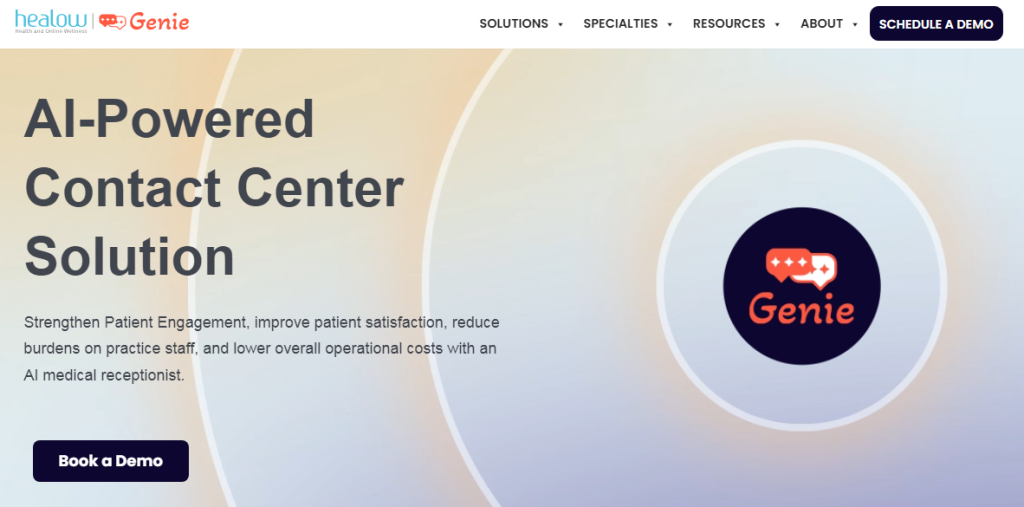
healow Genie is positioned as an AI-powered healthcare contact center with voice, text, chat, appointment management, after-hours service, outbound campaigns, and human escalation. Its official product pages emphasize access to practice data and connection to existing healow and eClinicalWorks workflows.
Best for: organizations already invested in that ecosystem and looking for a broad patient self-service layer. During a demo, verify which tasks are completed directly in your current EHR and which still create a staff queue.
2. BestDoc AI Call Center
BestDoc AI Call Center focuses on patient calls that lead to appointment actions. It can support booking, confirmation, cancellation, rescheduling, and patient onboarding while keeping the scheduling workflow connected to BestDoc practice operations.
Best for: clinics that want voice automation alongside online booking, scheduling, waitlists, communications, and practice-growth tools. The practical advantage is operational continuity: the phone call is not isolated from the calendar and patient-access workflow.
3. Prosper AI
Prosper AI presents voice agents for both patient and payer calls. Its current product scope includes appointment scheduling, intake, benefits verification, prior authorization workflows, billing questions, and EHR updates.
Best for: larger organizations trying to automate several patient-access and revenue-cycle call types. The buying conversation should include implementation ownership, payer-call exceptions, EHR write-back, and how staff review failed or incomplete calls.
4. Assort Health
Assort Health concentrates on patient access for specialty and multi-specialty healthcare groups. Its platform covers inbound conversations and proactive outreach such as referral scheduling, patient reactivation, rescheduling, no-show recovery, and payment follow-up.
Best for: specialty groups whose scheduling logic differs by service line, payer, location, or referral status. Ask the vendor to run a demo using your most difficult visit types rather than a generic primary-care booking.
5. Sully.ai
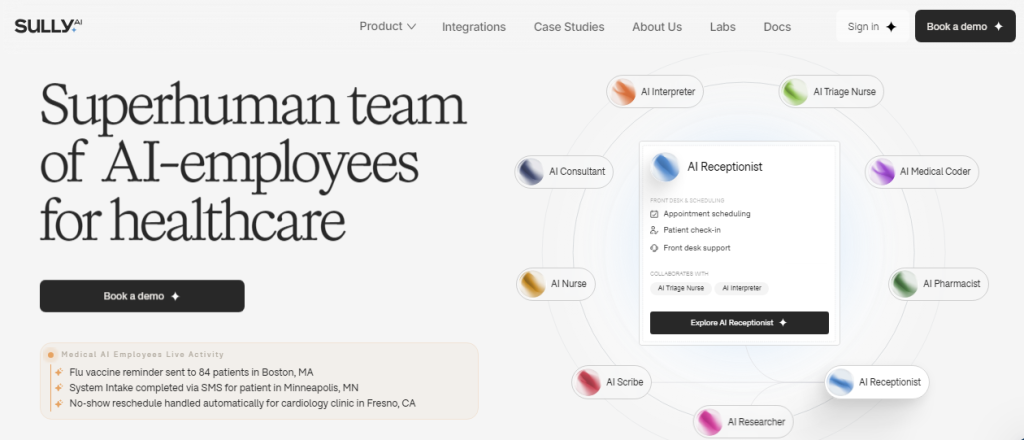
Sully.ai offers a wider set of healthcare AI roles, including a receptionist agent as well as documentation and operational agents. That makes it broader than a dedicated call-answering product.
Best for: hospitals or groups evaluating several automation workflows under one vendor. Confirm the boundaries between administrative and clinical tasks, and pilot one narrow workflow before expanding the scope.
6. Hippocratic AI
Hippocratic AI develops patient-facing healthcare agents for non-diagnostic interactions. Its positioning is closer to supervised patient engagement programs than a simple front-desk answering service.
Best for: health systems considering structured outreach, follow-up, education, or other patient-engagement workflows. Buyers should evaluate the evidence and oversight model for the exact use case they intend to deploy.
7. Telnyx Voice AI
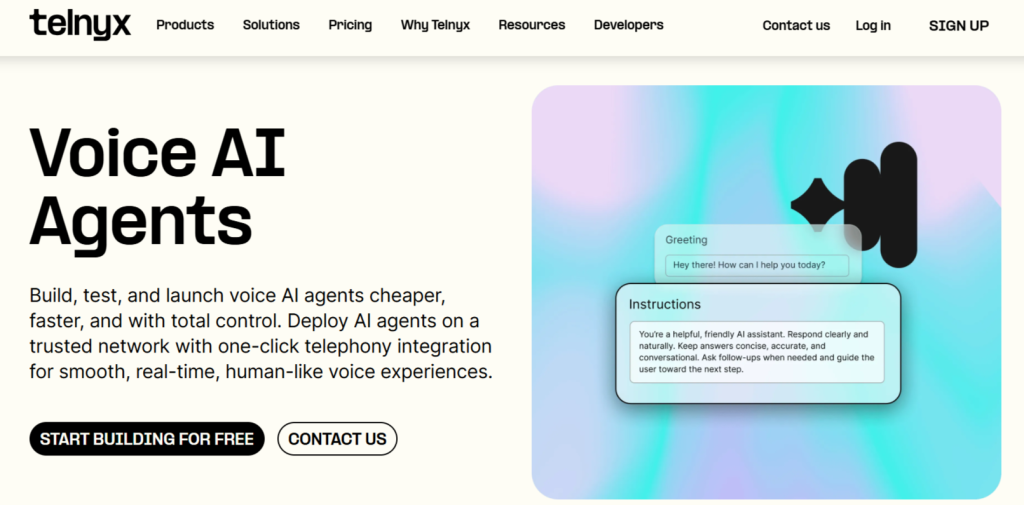
Telnyx Voice AI provides programmable telephony and AI components rather than a fully configured medical-practice workflow. Teams can combine voice infrastructure, speech-to-text, text-to-speech, routing, and their own business logic.
Best for: product and engineering teams that want control over the agent, integrations, hosting decisions, and calling infrastructure. That flexibility also means the customer owns more design, testing, compliance, and maintenance work.
Which type of healthcare AI call center is right for your organization?
| Your main problem | What to prioritize | Likely shortlist |
|---|---|---|
| Too many scheduling calls | Real-time booking, visit-reason rules, rescheduling, and calendar write-back | BestDoc, healow Genie, Prosper AI, Assort Health |
| Calls spread across locations | Location detection, shared configuration, provider routing, and reporting by facility | BestDoc, Prosper AI, Assort Health |
| After-hours patient access | Coverage rules, on-call routing, emergency language, and next-day follow-up | healow Genie, BestDoc, Assort Health |
| Patient and payer call workload | Eligibility, prior authorization, billing, and exception handling | Prosper AI |
| Custom voice product | APIs, telephony, latency, observability, regional hosting, and engineering control | Telnyx Voice AI |
| Broader health-system engagement | Clinical governance, supervised workflows, evidence, and human oversight | Hippocratic AI, Sully.ai |
A practical 30-day pilot plan
A polished demo is not enough. Pick one painful call type and measure it against a baseline.
- Choose a narrow workflow. Start with appointment requests, cancellations, after-hours overflow, or one high-volume specialty.
- Document the rules. List appointment types, provider restrictions, accepted locations, escalation triggers, and messages the AI must never improvise.
- Test realistic calls. Include accents, background noise, corrections, insurance questions, unavailable times, existing patients, and callers who change topics.
- Review failures daily. Track incorrect bookings, abandoned calls, unnecessary transfers, missing context, and staff cleanup time.
- Compare business outcomes. Measure answered-call rate, completed bookings, booking accuracy, escalation rate, average handling time, and staff hours spent resolving exceptions.
If the pilot does not create accurate appointments or clean handoffs, adding more call types will magnify the problem. If it works, expand one workflow or location at a time.
Questions to ask every vendor
- Can the agent book, reschedule, and cancel directly in our current scheduling system?
- How are provider, location, insurance, and visit-reason rules configured?
- What happens when the caller asks a clinical or urgent question?
- Which languages are supported in production, and how are they tested?
- Will you sign a business associate agreement?
- Where are recordings, transcripts, and extracted patient data stored?
- Can staff audit every action the agent took?
- How are failed calls, integration outages, and scheduling conflicts surfaced?
- What implementation work is included, and what remains the clinic's responsibility?
- How does pricing change with call volume, locations, workflows, and integrations?
Final recommendation
There is no universal winner. healow Genie is worth evaluating for organizations already using its connected ecosystem. Prosper AI and Assort Health address broader or specialty patient-access workflows. Sully.ai and Hippocratic AI belong in conversations about wider healthcare-agent programs. Telnyx fits teams that want to build rather than buy a finished medical workflow.
BestDoc is a strong fit when the immediate goal is straightforward: turn patient calls into accurate appointments while keeping scheduling, online booking, waitlists, and clinic operations connected. Before choosing any platform, insist on a pilot using your real rules and measure completed bookings rather than demo quality.
See how BestDoc AI Call Center connects voice automation with scheduling, or request a BestDoc demo for your practice. You can also compare the broader workflow in our guide to medical appointment scheduling software.